Category: Bible

  • The Tale of the Determined Squirrel…

    Since the beginning of the pandemic last March, I’ve had far more opportunity than normal to notice the wildlife in our garden. Over this now-more-than twelvemonth span, I’ve been drawn into the dramatic arc of daily life lived by the birds, small mammals and occasional amphibians that share the space I used to think of as ‘mine’, and now think of as ‘ours’.

    I’ve noticed the passers-through and the regular visitors, those who travel in pairs and those who come alone, the early risers and the night owls, those who flaunt their vibrant colours in the full-on flare of the midday sun. I’ve witnessed courtship rituals, the nurture of fledglings, the full-on panic of immediate threat to life, the sadness and the stillness of a life cut short. It is compelling.

    And this small, half-turfed, ordinary space has revealed itself to be a rich tapestry of tales I never knew were there.

    Like that of The Determined Squirrel…

    *****************************************

    I know some people who prefer to squirrel-proof their bird feeders, but I’m a big fan of the feather-free furball foragers who frequent our hanging café. Anyone who displays that much dedication to getting their hands on their food deserves nothing short of admiration and respect!
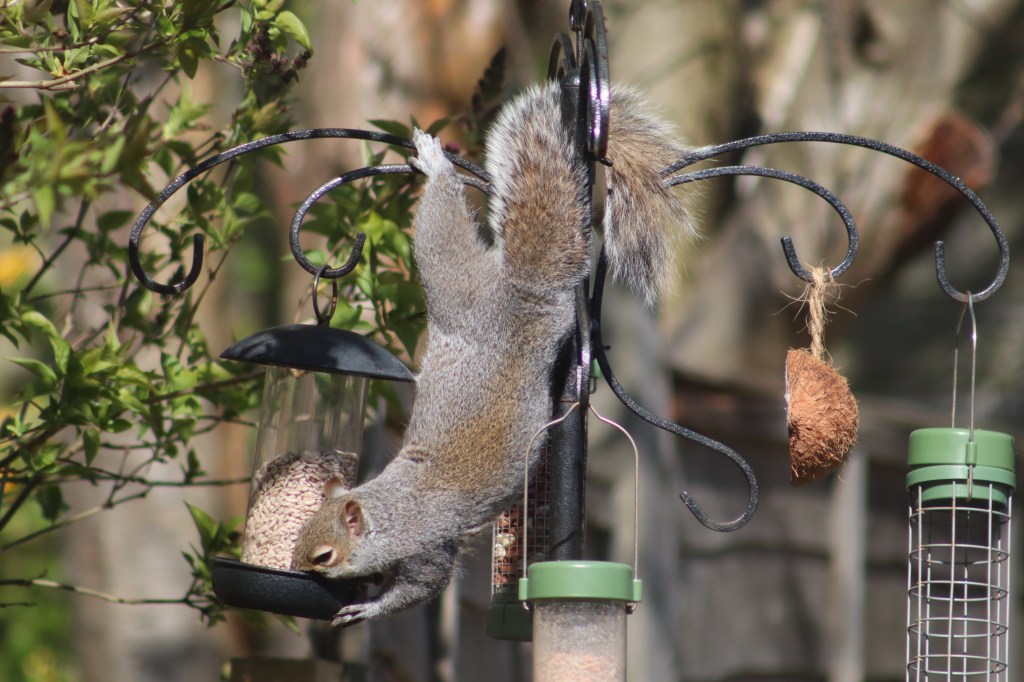
    Image © Julie Wilkinson 2021

    I’ve spent hours at my laptop with one eye on the squirrels – running along fences, acrobatically pilfering the bird feeders, and digging up the spoils they had stashed in my lawn. One day, I was in my kitchen when a familiar flash of grey fur flickered through the corner of my eye…

    That flash of fur was a squirrel, scampering down the bird feeder – by the time I looked up, it had settled itself in the grass below, right next to the cage feeder that was half-full of peanuts. It had just succeeded in knocking it off its hook, onto the floor, and looked mightily pleased with its endeavour!

    Dislodging the feeder to eat from it in a more comfortable fashion was not, however, the end goal. As I watched, like something from a cartoon, the squirrel proceeded to try everything it could to lift the entire feeder up off the ground, small furry arms stretched comedically wide, as it attempted to stagger off with the Holy Grail of peanut hoards.

    The squirrel was unbelievably determined. It tried everything. Lifting, carrying, pushing, pulling. At one point, it ran up the nearby fence post and sat atop the wood, surveying the situation from a height to see if it could come up with a better plan.
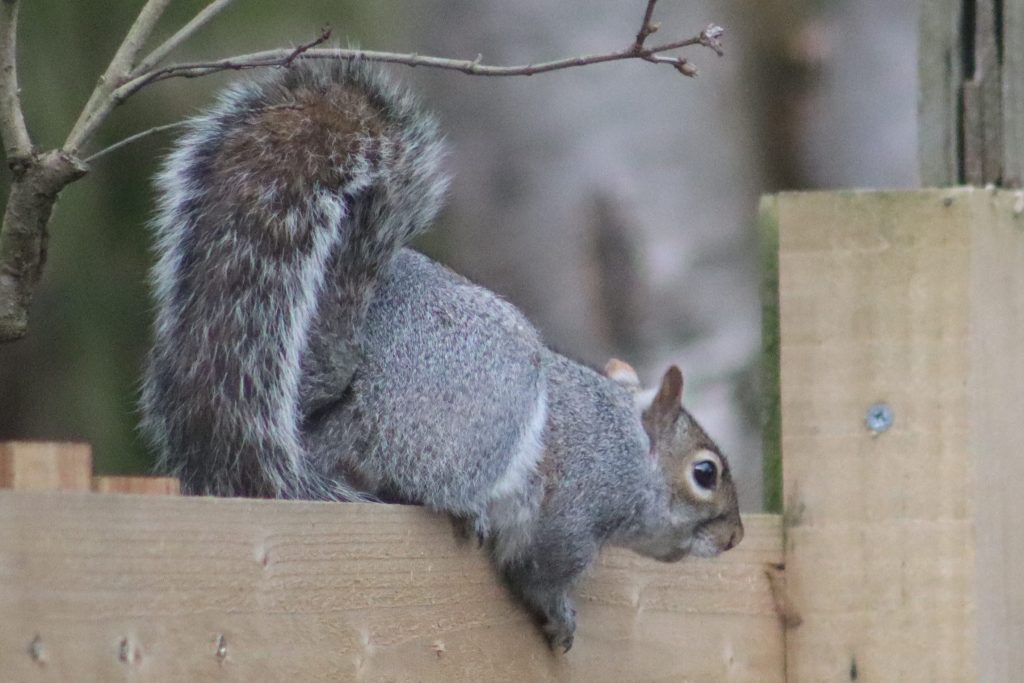
    Image © Julie Wilkinson 2021

    After several dogged minutes, circumstances forced it to change tack. Its efforts to steal the entire feeder and its contents resulted in the lid being dislodged and the peanuts spilling out everywhere. By the time we went out later to refill and rehang it, there were no peanuts left – some gobbled up, no doubt, by the opportunistic pigeons, but most, I suspect, taken and stashed for later by that stubborn little squirrel. And bravo to him, I say!

    *****************************************

    In Genesis 32, there’s a story about Jacob wrestling with God. Facing reunion with the brother he’d cheated out of his heritage, and fearing retribution, Jacob places his wives, children and servants in safety across the river, and returns to spend the night alone. He spends the dark hours wrestling with a man until the sun comes up. The man, seeing he cannot win, strikes Jacob on the hip, putting it out of joint, then asks Jacob to let him go.

    “I will let go of you,” replies Jacob. “If you bless me.”

    And so the man blesses him, saying, “You will no longer be called Jacob; from now on, you will be called Israel, because you have wrestled with God and with people, and you have won.”

    Jacob asks the man who he is, but he refuses to reply. So Jacob names that place Peniel saying, “I have seen God face to face, but my life was saved.”

    *****************************************

    Sometimes, when we’re faced with a problem that refuses to be solved, when things become intractable, when we can’t see how God will lead us through, or we’re trying to ignore his prodding to do something we don’t want to do to solve things, we can feel like Jacob. Like him, we are hanging on for dear life with no end in sight, clinging with faith to a God who has become both our assailant and our life belt.

    When that happens, we need to cling on with all the stubborn determination of a squirrel who refuses to give up wrestling a stash of peanuts he can never carry; we need to cling on with all the audacity of a man who, faced with God himself, cried out, “I won’t let go until you bless me!”

    When God left Jacob, he left him changed; the strike on his hip caused him to limp away from their encounter. Wrestling with God, holding on for his blessing, cannot leave us unchanged. There is a price to be paid; seeking God’s heart makes its mark, such an encounter will leave us challenged – and that can be uncomfortable. But it is a price worth paying…

    May your days be blessed – and if they’re not, hang on, the blessing will come!
  • On Empathy…

    Skara Brae 2

    Empathy. That’s where my thoughts have been. The power of real, deep heart-to-heart human connection.

    I spent some time on the Orkney islands in the summer. It was my first visit, fulfilling a soul-yearning for the area that I still don’t really understand. It’s a place that is rich in Neolithic history, the landscape literally stuffed full of five-thousand-year old human stories.

    We spent our first full day there visiting the archaeological dig at the Ness of Brodgar’s Open Day, the archaeologists on hand to explain the treasures they had found beneath our feet. And it was fascinating. How science, and care, and precision, and knowledge, and expertise, and the good old-fashioned hard graft of digging combined, enabling them to find and unearth and interpret the stories written into the ground, connecting humankind across thousands of years.

    And it was fascinating how an ancient community, even older than the pyramids, still had so many stories to tell, of how they lived and organised themselves, of extraordinary creativity and ingenuity, craftsmanship and artistry, society and shared living.

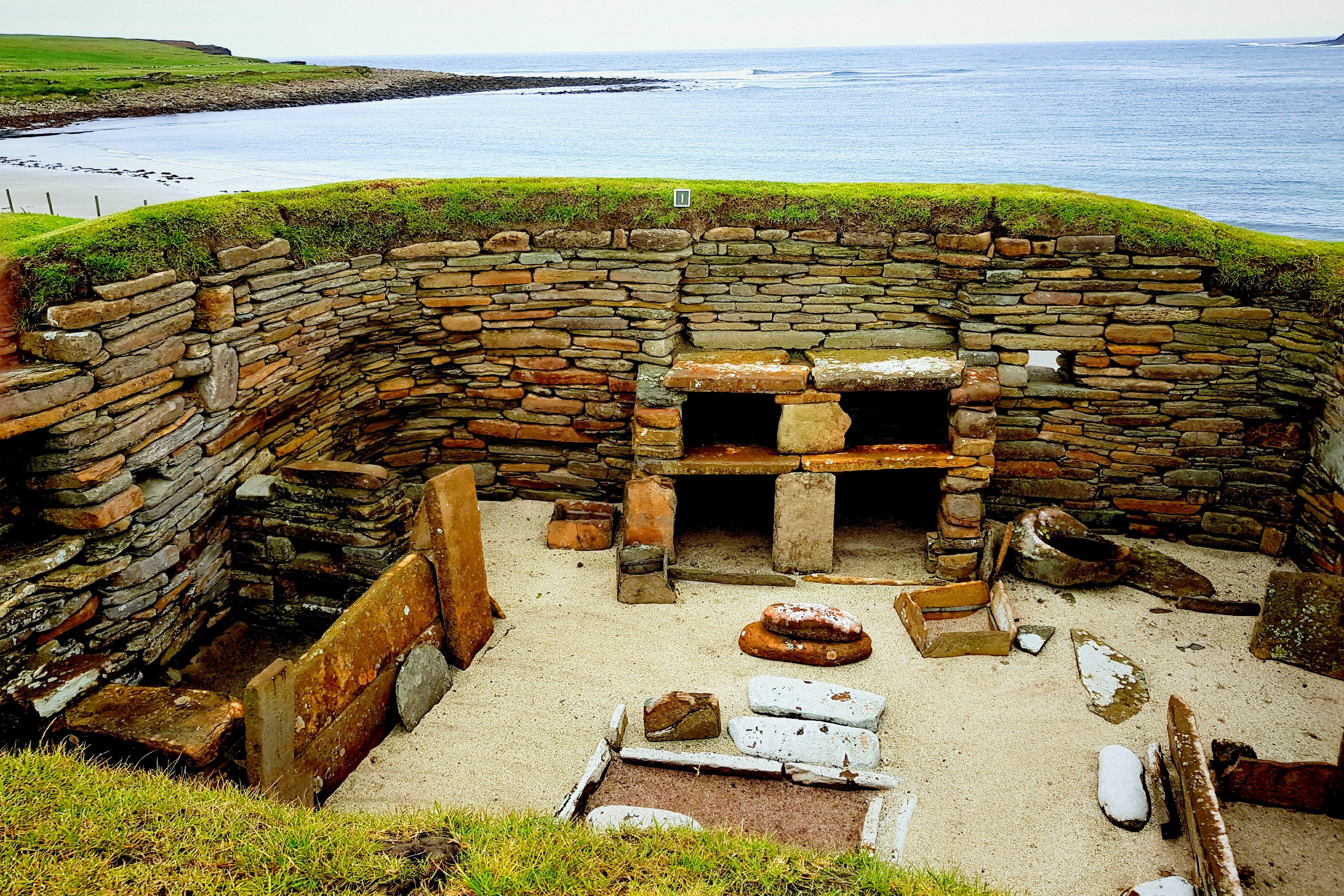
    As the week went on, we visited other five-thousand-year-old treasures. The chambered cairn of Maeshowe, engineered so its entrance was perfectly aligned with the light of the setting midwinter sun, and covered in runic graffiti, tagging the names of Viking invaders and their bawdy exploits. The standing stones at the Ring of Brodgar, built in line with the remains at the Ness and the cairn of Maeshowe, mysterious in their size and placement, hinting at Stone Age transport innovations and a shared communal spirituality. Skara Brae, the Neolithic settlement hidden beneath the sand dunes, uncovered by a nineteenth-century storm, revealing the perfectly-preserved secrets of our ancestors who lived there – a community who in all likelihood lived in family groups, gathering around a central hearth, sleeping in box beds, displaying their treasures on stone-built dressers. We saw the four-centimetre tall Westray Wife, the earliest known carving of a human form found in Scotland and one of only three such carvings found throughout the whole of the UK; a tiny stone person, with pin prick eyes, an M-shaped brow line, a possible nose and mouth below.

    And everywhere we went, there was human connection. Shared humanity. Shared values. Our Stone Age forebears were not primitive or inhuman; they were innovative and societal, craftspeople and artists, spiritual beings and master engineers, their monuments surviving for thousands of years.

    And it struck me time and again that the only reason we know all this, the only reason we can connect with them across millennia, is because of humans now – archaeologists, historians, volunteers and more – whose minds, hearts and souls yearn across the ages to connect with our forebears, to understand them. Empathy. Deep human connection.

    And it struck me that empathy, deep human connection – that is kingdom work. Jesus embodies empathy. He saw people, he read them, he understood. From the widow who gave all that she had, to the woman caught in adultery; from Zacchaeus in the tree, to his encounter with Judas at the Last Supper; in his response to Peter cutting off the soldier’s ear at his arrest, and in the way he allowed for the restoration of their relationship at the barbecue on the beach. He is all about empathy. That is at the heart of how he relates to people. When Mary and Martha sent for him as Lazarus lay dying, he delayed his journey – allowing for the greater miracle of resurrection, yes, but also for that short but well-known Bible verse. He wept. He allowed time to feel their deepest grief and loss alongside them. Empathy.

    In a world where so many of our political leaders choose to build a stance of unassailable power on bullying tactics and threats, on retribution and sanctions, it is empathy that is needed. Empathy is how we bridge the divide, geographically, culturally, spiritually, historically. Empathy is how we draw together across the division of values and beliefs. Empathy, built through shared stories and experience, founded on strong and sacrificial love for our fellow humans and our world.

    Shared humanity. Real, deep, heart-to-heart human connection. Hospitality and openness. Empathy.

    That is my choice. Join me?

  • Love is…

    1539694282186

    Love is fierce.

    Love is strong.

    It cowers, and bends, and withstands crushing pressure; it folds in on itself.

    Love clings, love grips, love hangs on in the storm.

    It looks for the spark of light when there is none.

    Love knows when it is not enough. It seeks unceasingly for the scaffolding to shore it up.

    Love weeps.

    Love mourns.

    It sacrifices itself again and again.

    Love is steel.

    It digs in deep. It bides its time. It burns slowly into bloom.

    Love survives.