Tag: Theology

  • We went in search of you…

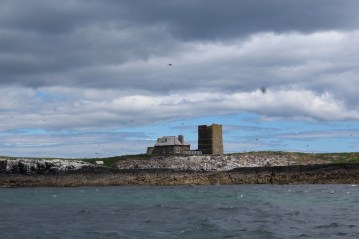
    IMG_3565We went in search of you,
    Wild and elemental,
    At home in the storm,
    With feet that walk waves.

    And we found you.
    In sand-blasted skin
    And salt-tanged lips,
    In sun-beaten cheeks
    And sea-sprayed hair,
    In briny-deep swell
    And wood-sweet smoke.
    In grit between our teeth.

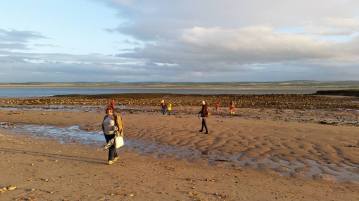
    IMG_3683

    We went in search of you,
    Spirit and creator,
    Bidder of oceans,
    Wilderness wanderer.

    And we found you.
    In swallows’ nest
    And rock-pool weed,
    In basking seals
    And pebble beach,
    In wide expanse
    And sinking-sun glow.
    In puffin’s clumsy gait.

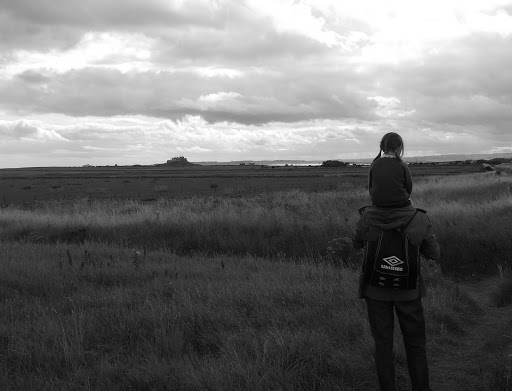
    19399003_10154429649171805_4509297819737855616_n

    We went in search of you,
    Incarnate and relational,
    Caller of all
    To hallowed community.

    And we found you.
    In a bunkhouse
    And in love that held our children,
    In the arms of beach-met friends
    And in nights of gin-soaked laughter
    Carrying us past the stars to first light’s dawn,
    In broken bread and sun-warmed wine.
    In gathering around the table.

    19400054_10154429645781805_4156806894185150538_n

    We went in search of you,
    Threaded through history,
    Eternally present,
    Holder of time.

    And we found you
    In your story
    And in ours,
    In a beach breakfast barbecue
    That echoed through time,
    In Cuthbert’s eyes and hands and feet
    And centuries-stretched shadow.
    In memories shared and memories made.

    IMG_3623

    We went in search of you.
    And we found you.
    Wild and elemental.
    Spirit and creator.
    Incarnate and relational.
    Threaded through history.

    We went in search of you.
    And we found you.


  • Floating around…

    I led a discussion about Noah last night. I hadn’t planned to. My vicar was supposed to be doing it. Then he phoned an hour before people were due to arrive at my house. He wasn’t well – could we manage without him? Of course! He needed to rest. Not a problem. More than happy to lead it. And I was.

    Only, when I sat down to think about it, I didn’t think I had much to say about Noah. And I wasn’t sure how to help others find something to say about it either. It’s a story everyone knows. Could there really be anything new to say about it? So I read it. And all I could come up with was –
    “There’s not much of a journey in here – they just sort of float around a lot, don’t they?”
    Genius.
    But somehow, through the conversation and the different perspectives that each person brought, by the end of the evening, I had found a new way of seeing the story.
    It’s always been a tricky one, Noah. Here’s a story of God obliterating all life from the earth, apart from Noah, his family, the animals and birds on the boat, and the sea creatures. Every other living thing is destroyed. Why? Because it’s not good enough. The wickedness of creation is so extreme that God is sorry he ever made it. But a God with regrets means a God who got it wrong… And how does that work?
    It’s so easy to read this story with the traditional Sunday School spin – gloss over the harshly judgemental God who destroys everything, concentrate on Noah who is saved because he is good. If only we could all be good like Noah…
    We didn’t find an interpretation of the story that made us feel at peace with God’s actions. But we did find a way of understanding it as a story containing a glimmer of hope, echoes of the God and his relationship with the world that become so much clearer in Jesus.
    Because even here, in the midst of such wrath and judgement, God doesn’t destroy creation entirely. He doesn’t wipe it out. He offers the chance for redemption, a fresh start.
    This is a story that comes relatively soon after that of the fall, after the moment when God’s relationship with mankind is altered and broken. But not broken beyond hope. Noah isn’t ‘good’ because he piously observes laws or never gets anything wrong – he’s good because “he walked with God.” Somehow, despite the shattered relationship between God and humanity, Noah has discovered the same relationship with God that Adam and Eve enjoyed in the Garden of Eden.
    And when God chooses to save Noah and his family, maybe it isn’t as a reward for being better than everyone else. Maybe he saves Noah because he wants to work with him, he has a job for him to do. Noah must save the birds, the animals, and the crawling things from the flood, he must take food, containing seeds and fruit. Noah must take on the task that God originally gave to Adam and Eve. He must take care of creation, and its potential, during this darkest of times, so that when it is over, creation can be redeemed and start again.
    There’s a moment as the flood waters are going down when Noah, having sent the dove out to find dry land, sees it return, reaches out his hand, takes the bird and brings it back safely into the boat. It is because he walks closely with God that Noah walks closely with the creation that still, in its most broken and ugly form, bears the image of the creator who made it. Noah’s relationship with God means that he can hear God’s voice, follow it, and play his part in redeeming creation, in building God’s kingdom. It’s a pattern of relationship that follows through the rest of the Bible, through Abraham, and Joseph, and Moses, and Joshua – right through to Jesus himself.
    We talked too about whether the story of Noah is a factual account of events that really happened or some kind of allegory, a story to help us understand the relationship between God and the world at this time – and did it really matter which it might be?
    Stories are powerful not because they are true or because they are made up. It is because they invite us somewhere outside ourselves. What we can experience is limited by time, and space, who we are, where we are and when we are. But through stories our experience is broadened beyond our own world. When we enter into a story – whether on film, in a book, in the theatre, or through the spoken word – we enter into another world and experience those events through our imaginations, almost as if we were there.
    If we are made in the image of our creator, a creator unbound by time and space, then our ability to experience things through our imagination has come from Him. And if we elevate factual experience, things that have physically happened, above the experience of our imaginations, perhaps we do that because of our own limitations. Perhaps from God’s perspective, the power and experience of the imagined is as strong as that of the physically experienced?
    I think we probably ended last night with more questions than answers. But a God who questions, who disturbs, who challenges me, is a God I’m happy to follow.
    And I do like Noah a little bit more now…
  • Adam and Eve

    We heard an interesting story on breakfast radio this morning. Bobby Charlton was due to welcome twenty six of the thirty three rescued Chilean miners to Old Trafford this evening, as guests of honour at Manchester United’s match against Arsenal.

    Sir Bobby’s father was a miner in Northumberland. My colleague pointed out that this was probably also the profession of his grandfather, great grandfather, great great grandfather and so on – the invite to the Chilean miners was based on a loyalty to and awareness of his roots, where he had come from, who he was.

    The genealogy in Matthew only goes back as far as Abraham, but the one in Luke 3 traces Jesus’ roots all the way back to Adam (and from there to God) – to the first story that there ever was. The story of creation and the fall has become a difficult one, tangled up in debates of creationism and Darwinism, science and faith, literal and figurative truth, mythology and fact. But strip that away and perhaps the story of Adam and Eve can shed a fresh light on the Christmas story and all that followed…

    The picture of Eden in Genesis is the image of creation as God intended it to be, unbroken, harmonious, good. When human beings are created God gives them sovereignty over creation, but it’s not a sovereignty of power and control – man is placed in the garden to care for it and to work it rather than to rule and to master.

    When God sees that it is not good for man to be alone, he reveals himself as a God of relationship and creates woman. She is created as a partner for man, a helper who is right for him, and they live in harmony with one another, with creation and with God.

    Yet over the centuries, this story of wholeness and accord has been used as evidence to justify man’s supremacy over the rest of creation, including woman – is that really what’s going on here?

    The creation story is told twice in Genesis in quick succession. When humans are created in Genesis 1, God commissions them to be masters of the earth, to rule over the fish in the sea and the birds in the sky and over every living thing that moves. Perhaps, reading that, it’s a natural assumption to make that we are special, set apart from the rest of creation in a position of prominence and importance, more highly valued than anything else.

    But the account in Genesis 2 reveals a different way of viewing this mastery of creation as God places Adam in the garden of Eden to take care of the land, to work it. I’m not an agricultural expert (I can’t even keep houseplants very successfully!) but the little I do know suggests that working the land involves careful tending, coaxing, nourishing, nurturing, to enable it to fulfil its potential – which reminds me of how God works with us. So doesn’t it make sense if that is the role God gives to us within creation, we who are made in God’s image as nurturers, bringing potential into fulfilment?

    When God creates Eve, there is no suggestion that she is made to be subservient to Adam. They are partners, just right for one another. Though God makes woman from man, she is made from man’s rib, taken from his side to stand by his side, equal. It is only as a consequence of the fall that their roles are separated, woman given the burden of painful childbirth and man the burden of working the ground hard for food – both direct consequences of breaking the harmonious relationship between humans and creation.

    And it is only with the breaking of creation that the struggle for supremacy as we know it enters the world, whether in the battle for power within humankind or in the domination of nature and the exploitation of the environment that we are now challenged to do something about. It is hard for us, from this post-fall perspective, to truly understand what a world without this struggle would be like – but the birth of Jesus makes it possible for us to begin working back towards that world.

    When God is preparing to send his son into the world, he invites Joseph and Mary, man and woman, equally to be part of his plan. And as Jesus grows and begins his ministry, he is remarkable within his culture because he accepts all equally – not just women, but the poor, the sick, the outsiders, the sinners. Jesus lives in relation to others as though creation were never broken, empowering those he meets not to raise themselves above others but to fulfil their own potential.

    In the Christmas story, in the birth of Jesus, God opens the path to restoration – not just of our own relationship with him, but of the whole of creation. Through his life on earth, Jesus shows us how to live to bring about that restoration. Through his death and resurrection, he provides the restoration of our relationship with God, making it possible to live that different kind of life.

    Jesus understood his roots. He understood that way back in time, his ancestors, Adam and Eve, had experienced the wholeness of unbroken creation. And he longed for the rest of humankind to experience that again. Every time we follow his example, working towards equality, valuing those who lose in the battle for power – the poor, the weak, the voiceless – and every time we follow Adam and Eve’s early example, caring for creation and honouring the role that God gave us, maybe we do a little bit of kingdom work and bring that restoration a step closer…


  • Jacob

    Every year, my husband and I go away for a couple of nights to celebrate our wedding anniversary, usually somewhere suitably romantic – rural Derbyshire, Lindisfarne, Fountains Abbey, Paris. So you can imagine my surprise when, three years ago, he announced that he’d found the perfect place to go for our fourth anniversary … Sunderland!

    I have nothing against Sunderland – indeed, it occupies a nostalgic little spot in my heart as the first home of my brother and sister-in-law, visits spent wandering the beach at South Shields or going to Beamish. But it doesn’t come top of my list of holiday destinations, romantic or otherwise!

    Fear not though – my other half hadn’t failed miserably on the ‘good husband’ front; he’d found a holiday cottage in a lighthouse and a good time was had by all. One of the biggest surprises of the trip was a visit to the Winter Gardens in Sunderland itself. There, in the middle of the city on a sunny-but-cold January day, we found an oasis of beauty in the most unexpected of places.

    At first glance, there doesn’t seem to be much beauty in the story of Jacob, many times great grandfather of Joseph and, through him, Jesus. He begins by tricking his brother and father into giving him the birthright of the oldest son, fracturing family bonds seemingly beyond repair. He is then tricked himself by his uncle, deceived into marrying the older of two sisters when it is the younger one that he loves and has worked for. Ultimately married to both sisters, with sons coming out of his ears (not literally!) and favouritism rife, this doesn’t seem to be a family worthy of the Son of God.

    The cycle of deception at the centre of Jacob’s story is embedded in the Old Testament workings of justice. Jacob has deceived his father and brother, so his deception at the hands of Laban (his uncle) is, in isolation, a restoring of balance. But this kind of justice is also deeply problematic – for each act of deception, while restoring one balance, creates an imbalance elsewhere, causing further damage.  Every time dishonesty occurs, the impact on innocent lives increases, stifling the potential God has created, whether that be the potential of an oldest son to be a good steward of his father’s wealth, or the potential for daughters to be loved and valued in healthy marriage relationships.

    Parental responsibility plays its role here – when Jacob deceives his father, Isaac, it is his mother, Rebekah, who instructs him in his dishonesty; when Laban tricks Jacob into marrying his elder daughter, Leah, he makes her complicit in the ruse. Both stories reveal parents encouraging their children in the art of deception, almost teaching them how to deceive. And this parental involvement almost inevitably takes place against a backdrop of favouritism – as the youngest of twins, Jacob was his mother’s favoured son, while his brother Esau was his father’s. This is a mistake which Jacob repeats with his wives, favouring Rachel over her sister, Leah, and later on with his sons, favouring Joseph and Benjamin (Rachel’s children) over their brothers.

    I wonder if what we’re seeing here in these cycles is still the fallout from Adam and Eve and the breaking of creation? We can literally see the waves of pain spreading and rippling through the generations, becoming a more and more natural part of how they live their lives.

    So, are there any signs of hope in the midst of this destruction?

    Yes – for although creation is damaged, God’s image remains reflected in it, however brokenly.

    And that means that a man like Jacob, capable of unthinkingly inflicting great pain on his closest family members, is also capable of a depth of love that can only be described as godly. His love for Rachel is characterised by a timeless patience and constancy that made seven years’ labour seem “like only a few days to him because of his love for her.” A reflection of God.

    And it means that a woman like Leah, tied in marriage to a man who will never truly love her and forever in the shadow of her more beautiful and beloved younger sister, can name her fourth child Judah – meaning ‘praise’. In the midst of her painful, compromised life, Leah responds to God’s blessing of a son with praise.

    It is from this family line – Judah, son of Jacob and Leah – that the genealogy of Jesus comes. From this bleak, messy tangle of relationships, bearing all the rawness of the fall and separation from God, comes Jesus.

    And Jesus comes to bring a new kind of justice, showing a better way which wipes out the wrong things we do and releases us from the old cycles causing ever more damage.

    Jesus comes into our broken world because God sees his image reflected in us and wants us to fulfil that potential. When Jesus tells the woman caught in adultery to go and sin no more, he does so with no judgement, no condemnation of her wrongs – but perhaps with a desire to see her recognise the signs of God in herself and become the person he meant her be, to fulfil her potential.

    Maybe the lesson to learn from Jacob is to look for and truly see the signs of hope, the beauty among the brokenness, the signs that God is present in the world which shine ever more brightly when they shine in the darkness – perhaps none more so than the baby whose birth we remember each Christmas…

     
  • Judah and Perez

    I recently read The Thirteenth Tale by Diane Setterfield (it’s very good, I recommend it). It tells the tale of the reclusive and mysterious author, Vida Winter and opens with a quote from her fictional collection of stories:

    “All children mythologize their birth. It is a universal trait. You want to know someone? Heart, mind and soul? Ask him to tell you about when he was born. What you get won’t be the truth: it will be a story. And nothing is more telling than a story.”

    Thinking about it, there’s definitely some truth in there. Ask me to tell you about when I was born and I’ll tell you how I made my entrance into the world almost two weeks after my due date – and haven’t stopped being late since!

    For Perez, the fifth ancestor listed in the genealogy of Jesus, we don’t know much about him apart from the details of his conception and birth. To be honest, before I looked him up last week, I wouldn’t have been able to tell you who he was or anything of his story. But he does stand out in the genealogy – he’s one of the few listed with both parents, mother as well as father. At a time when women were culturally subordinate, it was very unusual for a Jewish genealogy to mention them at all; but five women appear in that of Jesus.

    Perez’s father was Judah, one of the twelve sons of Jacob and a brother to Joseph. His mother was Tamar, Judah’s daughter-in-law. And so begins one of those Old Testament tales of tangled, messy family relationships that are so common in Genesis…

    After helping the rest of his brothers to fake Joseph’s death and sell him to some Midianites, Judah left home and went to live in another town where he met and married his wife. This marriage resulted in three sons – Er, Onan and Shelah. When the time came for Er to have a wife of his own, Judah chose Tamar to fulfil the role.

    Unfortunately the marriage didn’t last long – Er did things that God said were wrong, so God, in one of those moments we find so uncomfortable, killed him. In line with custom at the time, Judah told his second son, Onan, to take Er’s place as Tamar’s husband. But Onan wasn’t keen on providing descendants on his dead brother’s behalf instead of his own so he made sure he didn’t fulfil his marital responsibilities (to put it delicately!). God wasn’t happy with Onan’s deception, so he killed him as well.

    With only one son left and fearful that he would also die, Judah sent Tamar back to her father’s house and told her not to marry until his third son, Shelah, was old enough to be her husband. Time passed, Judah’s wife died, and Shelah grew up – and Judah failed to keep his word to Tamar.

    Hearing that her father-in-law was going to oversee the shearing of his sheep one day, Tamar changed out of her widow’s clothes and, covering her face with a veil to disguise her identity, went to wait for him. When Judah saw her, he assumed she was a prostitute and approached her, promising to pay her with a goat from his flock in return for her services. Knowing he hadn’t recognised her, Tamar agreed – as long as he left her his seal, cord and walking stick as a returnable deposit. Their encounter resulted in Tamar’s pregnancy – but when Judah sent a friend back to make payment of a goat, Tamar was nowhere to be seen.

    Three months passed before word reached Judah that his widowed daughter-in-law had been acting like a prostitute and was now carrying a child. Judah condemned her immediately, declaring that she should be burned to death. When the people arrived to take her to her execution, Tamar sent a message to her father-in-law along with the seal, cord and walking stick – these were the things that revealed the identity of her baby’s father. On seeing them, Judah realised the hypocrisy of his mistake and granted her a reprieve, recognising that her actions were out of desperation because he hadn’t fulfilled his promise of marriage to his third son.

    After nine months of pregnancy, Tamar gave birth to twins. The first baby stuck his hand out and the nurse tied a red string on it so they could recognise him as the firstborn – but he then pulled his hand back in and the other baby was born first. So the firstborn son was named Perez (meaning ‘breaking out’), and the second named Zerah.

    Judah finds himself in the same position of power over Tamar as Joseph did with Mary, both men making life or death decisions in response to pregnancies outside marriage. Unlike Joseph, Judah doesn’t hesitate to judge and condemn Tamar. Was this a simple moralistic response or was his fear of the death of his third remaining son in the back of his mind, the death of Tamar a convenient way of removing this threat?

    For Tamar, life after the deaths of Er and Onan would have been one of limbo, waiting and waiting for Shelah to grow up and for Judah to fulfil his promise of a third marriage. Unable to live independently, reliant on a father-in-law who had abandoned his commitment to her, her actions, though deceptive, become understandable. Her encounter with Judah is both brave and foolish, a desperate self-assertion to change her circumstances, risking death rather than continue as the non-entity she had become.

    The positions of Judah and Tamar reflect the world that Perez was born into, one still reeling from the shockwaves of broken creation. His birth itself reflects the struggle for supremacy, the hierarchy of the firstborn, winning the battle with his twin brother to gain that position (with echoes here of Jacob and Esau).

    But perhaps these are the kinds of things, the broken things, that Jesus came to heal? To free people like Judah from fear and from cultural expectations to judge others harshly? To free those like Tamar who are disempowered and subject to the will of others? To show an alternative to the battle for power, a way of peace and justice and servanthood?

    Which brings us back to Joseph’s response to Mary, so different to Judah and Tamar. Even before his birth, Jesus’ story is changing things, showing a different way, a better way, repairing that which was broken and building a new kingdom…

     
  • Joseph

    We became parents for the first time last January when we adopted our three year old daughter. She’s full of energy, has a great sense of humour and loves David Tennant. She also growls “argh” when she’s annoyed (just like her dad), plays drums on her legs (just like her dad), and shouts “Come on Bradford!” when the football’s on (just like her dad!).

    Jesus’ genealogy hangs on Joseph – a man with whom he has no genealogical link. Joseph is the gateway through which Jesus descends from David, Isaac and Abraham, from the tribe of Judah, fulfilling Old Testament prophecies – yet this bloodline is not one that they physically share.

    I’ve always thought Joseph’s role in the Christmas story is a bit underplayed. Much is made of Mary, of her brave decision to do God’s will and be mother to his son – whereas Joseph tends to get sidelined. But if God chose Mary to be Jesus’ mother, didn’t he choose Joseph to be Jesus’ adoptive father just as much?

    When Joseph discovered that Mary was pregnant, he could have had her stoned to death for adultery (an avenue that some of his ancestors took very readily!) – but he didn’t. Why not? Because he was a good man. Instead, he planned to divorce her quietly – giving God the space to send an angel in a dream and invite him to be part of the plan.

    I have a friend and colleague who’s been talking about this recently in school assemblies, wondering what would happen if those involved in the Christmas story said no when God invited them to work with him. He talks about how God will always find another way, how it’s us who miss out on working with God when things go ahead without us.

    I don’t disagree – I’m sure if Joseph had said no, divorcing Mary and leaving her with no protector or condemning her to death, God would have found a way to work things out. But I’m much more interested in that moment of vulnerability that God puts himself in, in order to work with us. When Mary goes to Joseph, carrying God’s unborn son inside her, for that moment everything hangs on his response.

    Joseph’s decision to marry Mary and be Jesus’ father is as life-changing for him as Mary’s decision is for her. To all intents and purposes, he was Jesus’ father – their community assumed the paternity was his and Jesus was known as the carpenter’s son.

    But God also honours Joseph’s decision and involves him fully as parent and protector to Jesus. It is Joseph who is visited by an angel in a dream, telling him to take Mary and Jesus to Egypt to protect them from Herod – and Joseph obeys, fleeing in the middle of the night to a strange country and resettling his family there. Similarly, he obeys just as quickly when another angel appears, telling him Herod is dead and that it is safe to return home. Following the path he’s chosen, Joseph willingly uproots himself and turns his life upside down at God’s command to look after his family and protect his son – isn’t that what any good father would do?

    There isn’t a lot of information about the role Joseph played in Jesus’ life beyond the Christmas story – but there is more than I’d realised. The stories in Luke 2 of Mary and Joseph presenting Jesus in the temple and receiving Simeon’s blessing show a family that takes their place within a community. And there’s an easily missed but quite lovely verse at Luke 2: 40, giving a picture of how God worked in partnership with Joseph and Mary as Jesus grew: “The little child began to grow up. He became stronger and wiser, and God’s blessings were with him.”

    Our daughter has no genetic link to either myself or my husband. Yet there are many ways (increasingly more and more) in which she resembles us. Some of these are good, others are less so, but they all reflect the impact that we have on forming her character.

    All of which raises an interesting question about the decision God made when he chose Mary and Joseph as Jesus’ parents. For if Jesus is fully divine, then his Godly character must already have been formed and present throughout his earthly life. But if he is also fully human, then he must have been open to the influences of those with whom he had significant relationships. Just how much of an influence on the development of Jesus’ character did Mary and Joseph have?

    When the adult Jesus reaches out to women, valuing them as people in a culture that regards them as property, he reveals the characteristics of his heavenly father. But he also follows the example of his earthly father who, finding himself in a position of power over a vulnerable and culturally disgraced pregnant woman, showed mercy and provided protection. When the adult Jesus heals the sick, washes the feet of his disciples, or breaks the bread, he reveals the characteristics of his heavenly father. But the hands he uses have been shaped and trained by his carpenter father in the workshop.

    And there, right at the heart of the incarnation, God reveals himself as a God of relationship, committed to working with us even through the family of his own son. 


  • Welcome…

    I start with a confession. I’m a genealogy geek. I’m fascinated with the line of ancestors that have gone before me, the people they were, the places they lived, the decisions they made, and how all of that forms the foundation from whence I came and on which I stand.

    I’m also a storyteller. Stories are a vital part of who I am, of how I make sense of things, of how I discover and refine what I know as truth. Stories are part of my identity.

    And I’m a Christian. (Perhaps that’s more of a confession than the genealogy bit…!) And by that, I don’t mean that I’m religious, that I go to church every week, that I believe good people go to heaven and bad people go to hell. I mean that I believe in God, I believe that creation and the people who inhabit it have enormous potential and I long to see that fulfilled, and, in an attempt to play my small part in fulfilling that potential, I take inspiration from Jesus and the Bible.

    That’s the story I find myself in (to quote Brian McLaren).

    As a storyteller, I’m always looking out for things I’ve not spotted before in well-known Bible stories, the gaps that haven’t been filled – the hidden spaces. At this time of year that can be quite a challenge, going through the ever familiar Christmas passages. So I thought I might do something a bit different…

    In the same way that I’m fascinated by my own genealogy, I find myself increasingly drawn to that of Jesus. The long, boring list of names at the beginning of Matthew – that interests me! When I read it, I find myself wondering who the people were behind the names? What’s their story? And how might that shed a new and different light on how I understand Jesus?

    So, in time-honoured genealogical tradition, I thought I’d do some research! I start this journey without really knowing where I’m going – I don’t know how many of the names listed in Jesus’ ancestry appear elsewhere in the Bible or whether I’ll find out anything I didn’t know before. The results probably won’t be earth-shattering or life-changing. But they might be a little bit interesting…

    Here, I’ll be retelling some of the stories that interest me – some may be overwhelmingly familiar, others may be as yet unknown to you – alongside thoughts and questions that pop up as I go.

    This is my advent, my waiting, my preparation for Christmas. Join me?